Author: Fenton
Tourists in the Jungle – Monkeys
On the way from the airport in Belize City to Chan Chich, we drove through a small town and saw a sign warning of a ‘baboon crossing’ – “baboons in Belize,” I queried Bruce? “Black howler monkeys,” he responded. The locals referred to them as baboons. Everywhere we walked while we were at Chan Chich, and every morning as part of the dawn chorus, we were treated to the sounds of howler monkeys. The male howlers roared to let other howler troops know where they were and to declare their territory. It’s no wonder that the Mayans thought the howlers were some sort of demons. Their roars could be easily taken as some sort of great, vicious beast just looking for people to eat. One of the other guests said she saw a howler troop regularly along a trail that ran parallel to a small stream. I walked the same trail – no howlers. I tried mightily for a week to spot howlers and get a video of them – to no avail. I guess they just didn’t like me!
On another day, Carol and I were walking along a trail when we heard what sounded like someone or something crying and screeching. We stopped, listened, and looked. Off to the side of the trail, within the trees, we saw a lone, smallish spider monkey. The monkey was slowly moving through the trees and stopping at intervals to cry-out, to screech. We concluded that it was a lost or abandoned child looking for mom or family. We quietly walked on.

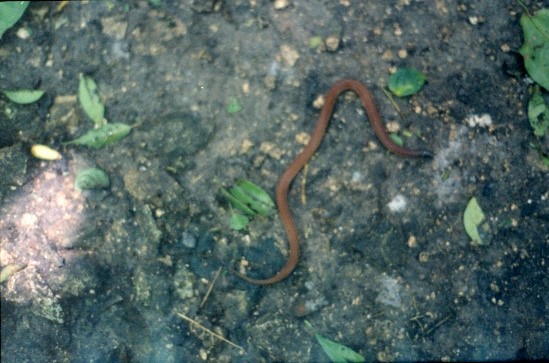
Not long after seeing the young, distressed spider monkey, we saw the only snake we were to see while in Belize. It was a small brownish critter about six or eight inches long. I have looked in my critters of Belize book and can’t find anything that looks like it. We did see some lizards around our cottage. A skink of some sort that disappeared under the cabin before I could get a good look and what looked like a gecko in the ceiling.
On our last day at the lodge, one of the other guests called out to us. There, up in a giant fig, was a troop of black howlers. They were not making much noise and were moving slowly along eating leaves. The big male would stop every now and again and sort of look around. One of the females was carrying a baby. We all found chairs or chaise lounges and parked ourselves below to watch. I started to take a video of the monkeys – foiled — the batteries were dead, as were my spares. Isn’t that the way it always happens? I had been trying for a week to see and video howlers; now here they were, and my camera was dead.
As we sat and watched, we all heard a commotion from off to one side of the tree with the howlers. A spider monkey was swinging and prancing through the trees, headed straight toward the howler troop. As we watched, the spider monkey commenced harassing the howlers. It would swing from a limb or dash along a big branch and snatch at the coats of the howlers. The howlers would move slowly away, apparently trying to ignore the pest. The spider monkey seemed to take particular joy in bothering the female howler with the baby. The howler mom just moved closer to the big male, but he didn’t appear to do anything. None of the howlers ever seemed to do anything that looked defensive, they just moved along, fed themselves, and tried to avoid the spider monkey. The spider monkey kept up its harassment for maybe 30 minutes as the howler troop moved slowly on and eventually disappeared from view in the canopy. I have never heard of such a scene before – not in any of the many documentaries I’ve watched on primate and other animal behavior.
Tourists in the Jungle – Ants, Jaguar Tracks, & Squirrels
During our week’s stay, Carol and I wandered the trails that the Chan Chich lodge had developed and maintained. One trail went along an ancient Mayan road for a distance. It was slightly raised and bordered by stones. Carol was interested in ants, having done her dissertation on them. Everywhere we walked and looked there were trails of leaf-cutter ants. Lines of waving green parasols across the paths and along fallen tree trunks.
There was another species of ant that seemed to associated with fallen tree trunks and other forest debris. They were fat little critters with striped-looking distended abdomens. In some respects, they looked a bit like giant versions of the honey ants Carol had worked on for her Ph.D.
On one treck, I walked up a hill along a sort of cleared area trying to see howlers that I could hear in the trees nearby. I was busy looking up. When I looked down, I was standing on the edge of a trail of army ants. A quick step backward, and I was clear. The marching army of ants was about three feet wide. The army extended across the cleared area – perhaps a skid road from logging – which was about 15 or 20 feet wide. I couldn’t see either end of the army. I jumped over the marching army and continued my search for howlers.
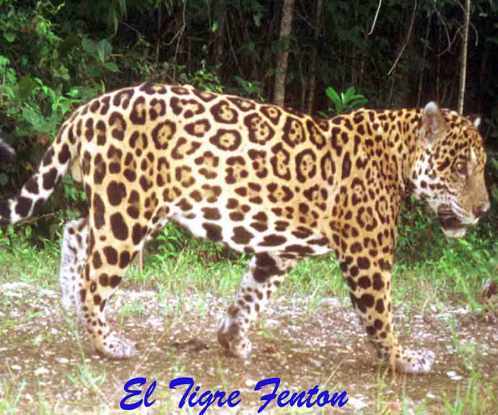
One afternoon Carol had decided to soak in the lodge’s pool, so I did a bit of a walk-about on my own. I was walking along a trail near a small stream. The ground was wet – it had rained the night before – and there in the middle of the trail were jaguar tracks. Apparently, a female with a cub had walked there not too long before I had come along. It was evident that the cub had been gamboling as the female walked along the path in a straight line. The tracks disappeared off into the forest. That was the closest I came to experiencing a real live jaguar. Sometime after Carol and I came home, I received a photo of a magnificent male jaguar that Carolyn had named Fenton – El Tigre Fenton.

Unfortunately, El Tigre Fenton came to a bad end. I understand that he was shot by a rancher for killing livestock. The jaguar may or may not have been guilty, but, like with wolves in the western U.S. he was a predator, cattle had been killed, he was in the vicinity.
A few yards further along the trail I heard a chattering sound. I stopped and looked around. The noise came from a tree on the side of the trail. As I stood still and watched, a squirrel poked its head around the tree trunk, and it chattered at me before disappearing up the tree. I managed to get a little video of the squirrel, but not much and not very good.
Alley Oop! – Tower Jumpers, Cartoons, Paratroopers, and Rock & Roll
It’s funny, the things a person gets to thinking about. The other day, while sitting on the thunder mug, I suddenly started thinking about Alley Oop. You know, the cartoon character; big forearms, scruffy beard; rode a dinosaur. How could I forget the characters? Alley Oop, the time-traveling caveman, getting into all sorts of adventures. Oola, his girlfriend. Dinny, his dinosaur. Dr. Wonmug, the mad scientist that invented the time machine that found and transported Alley Oop. The Kingdom of Moo. A satirical, bonafide sci-fi comic strip.
Then I got thinking about where did that name come from? I had heard that it was from the French. Apparently, circus-type acrobats would shout “Allez oop!” then jump into a wet hanky or some such. It seems to me that I heard, probably from WW-II movies I watched as a kid, that American (and maybe other) paratroopers would shout “Alley Oop!” as they jumped from their aircraft.
Hmm! OK, what came first? So I Googled Alley Oop. What did I find? Well, the origin apparently is from the French. Allez (from aller, to go) used as an interjection of encouragement, surprise, or exhortation + oop – uncertain or unknown. [exerpted From Webster’s New World Dictionary, 5th Ed., Houghton, Mifflin Harcourt Publishing Co].
Now here’s where I had forgotten or never really knew, all sorts of things about the term ‘alley-oop’.
- Basketball – A play in which a pass is lobbed above the basket, and a player jumps and attempts to dunk it in the air.
- Used to start a strenuous activity, such as lifting.
- French cry of a circus acrobat about to leap from a tower.
- An American comic strip created in 1933 by V.T. Hamlin – the caveman character from the strip. [Extracted from YourDictionary, n.d. https://www.yourdictionary.com/alley-oop]
- A hit single in 1960 by the Hollywood Argyles – their only hit. The song, written 1957, has been covered by numerous other groups since it was first recorded. [extracted from Wikipedia]
With all of this, I discovered that the cartoon strip has run, almost continuously, since it’s inception in 1932. It is still running. Hamlin’s assistant, Dave Graue, took it over in 1971. Jack Bender started illustrating the strip in 1991, and he and his wife continued the strip after Graue retired in 2001. The Bender’s retired in 2018. A 2018 article by Bruce Haring stated that the strip was to be revitalized, with a new writer/artist team in the NY Times.
I haven’t read any cartoon strips for several years, so I was totally unaware that the strip still existed. As a kid, it was one of my favorites. I would lay on the floor in my grandma’s house on Sunday morning and read the Sunday Funnies while listening to them being read by a team on the radio. Even as an adult, I subscribed to several different newspapers over the years, and the first thing I always read was the funnies – weekdays and Sundays. Somewhere along the line, I lost interest in reading newspapers, and the cartoons went, along with the subscriptions.
Did paratroopers really shout alley-oop as they jumped?
Tourists in The Belize Jungle -2
Tourists in the Belize Jungle – Birds
Our cottage at Chan Chich was situated right next to a temple hill with a large tree on top of it. The tree was full of Montezuma’s Oropendolas flying in and out of their hanging nests. Nests that were very reminiscent of large bull scrotal sacs. The tree was a constant flutter of flying birds and noise as they talked to one another. We were awakened every morning by the dawn chorus, which consisted mainly of the calling of the oropendolas.
Every morning and in the evening, dosed with Deep Woods Off against the mosquitos and black flies, we would sit on the veranda of the lodge drinking either morning coffee or evening Belikan beer and watch the hummingbirds. At least four species of hummingbirds were working the flowers that grew around the periphery of the lodge. Watching them feed on nectar and scuffle among themselves was never dull. I did manage to get some footage of the hummingbirds. Colorful, quick, buzzing wonders.

The pathways within the grounds of the lodge were home to a variety of bird life. Ocellated Turkeys strutted around and did their turkey thing. Ocellated Turkeys are an endangered species and have been disappearing from much of their range throughout Central America. You’d never know that at Chan Chich. There was a flock that occupied the grounds daily. We also saw them frequently along the road as we were traveling back and forth between the lodge and Bruce and Carolyn’s digs.
Melodious Blackbirds fussed at one another, sang their choruses, and searched for insects in the grass. The Melodious Blackbird, to me, is an example of one of the great anomalies in nature. Probably because I am a human, I operate pretty much within the domain of human thoughts, ideas, perspectives, and biases. My mind tells me that things that make beautiful sounds should also be beautiful in appearance. Things that make raucous sounds should be dull or something, but not impressive. Melodious Blackbirds are about as plain in appearance as anything you can imagine. Shiny, black birds. Oropendolas, on the other hand, are gorgeous, colorful birds – black with yellow heads. Toucans are generally black or dark feathered but have huge colorful bills. But … Melodious Blackbirds, as their name implies, have a simply beautiful melodious song and they sing it at one another more or less continuously as they move about and forage. Oropendolas and toucans have raucous, non-melodic calls. One might refer to the call of oropendolas as a song, but it is to the blackbird’s song as rap is to Ella Fitzgerald’s blues renditions.
Flocks of parrots flew overhead every day. There are eight species of parrots in the general area, and all are green from sixty feet below. The parrots were always noisy and didn’t sit still for long. They were always high up in the canopy of the forest and probably were busy eating whatever fruit was currently available. I tried to get videos of them, but the telephoto on my camera just wasn’t up to the task. Lots of noisy, green, flying pixilated blurs.
The occasional toucan made an appearance. There are three species of toucans in the area. We have no idea which one we saw flying overhead. You would think that the large colorful bills of the toucans would be easily visible and the birds easy to identify. No such luck. Just like the trogons in the Mexican pine-oak forests that I visited as an undergrad, the toucan’s beak colors just sort of disappear. Trogons are beautiful green plumaged birds. You can hear them calling in the upper levels of the forest, but you seldom see them. So, too, the toucans. On one of our walks, Carol found a toucan bill on the forest floor. No color – it was just bone – the remnant, no doubt, of some predator’s lunch.
On her walk from Bruce and Carolyn’s house to the lodge, Carol saw a Chachalaca, albeit briefly. Wandering around the grounds one late afternoon, we saw a Crested Guan high in one of the trees. No details, just the unmistakable outline – plus prompting from Bruce. That seems to be the story of birding in a tropical rain forest. Without binoculars, you mostly don’t know what you are looking at. Even with binoculars, you often don’t know just what you are seeing – at least until you spend enough time watching to get familiar with what you are viewing.
Tourists in the Belize Jungle
Tourists in the Belize Jungle – Belize 2000

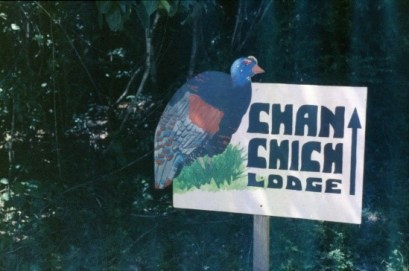
My wife, Carol, and I were staying at a nature lodge near Gallon Jug, Belize called Chan Chich – Mayan, we were told, for Little Bird. The lodge was situated in the plaza of a Mayan temple complex. What appeared to be hills surrounding the lodge were ancient temples, now overgrown with tropical forest.

The cottage we occupied was faced on three sides with a covered porch that hosted a couple of chairs and, along one side, a canvas hammock. The single large room had a dresser and a chair and a queen-sized bed. The ceiling was open, and we could see the palm-leaf thatch that covered it. It was, however, completely water-proof. That was a necessity since we were in the ‘little dry season’ between seasonal rains. As with most tropical forest Chan Chich basically had two seasons, the wet and the dry. In the middle of the wet was a less rainy period called the little dry season. The little dry was not a big tourist season, so only one or two other families were staying at the lodge.
Carol and I were both products of the western U.S. I was raised in the deserts and Carol in Denver, Colorado. We had met in graduate school in southern New Mexico, the Chihuahuan Desert. However, we had done post-doctoral training in Florida and had visited Puerto Rico, so we had a smidgen of understanding of tropical environments. We had not realized just how tropical Florida was until we drove from the airport in Belize City to Gallon Jug with our friends Bruce and Carolyn.
We were simply amazed to see pine flatwoods with palmetto trees that looked just like those we had known in Florida. As we moved into the interior of Belize, however, the environment changed and became truly tropical forest – jungle. We had seen similar forest in Puerto Rico in El Yunque National Forest, but the Belizean forest was different. Towering trees, most of which I couldn’t name, other than knowing that some of them were figs – that is in the genus Ficus. There were also mahogany trees, which provided a lumber industry. We saw numerous stacks of logs and logging trucks.
We were in Belize as guests of our friends who lived in Gallon Jug. Bruce and Carolyn were conducting research into aspects of the Belizean fauna for an international wildlife conservation group. Bruce was doing studies of bats using their echolocation calls to identify the various species and how they utilized the forest and the open areas created by agriculture or logging. Carolyn was in the midst of a study trying to identify individual jaguars by their tracks. I was there to try to help her with the statistical analyses. Similar work had been done in India on tigers and in North America on pumas. The prior studies had shown that multivariate analysis of measurements of components of the animals’ tracks could be used to identify individual animals. With that information, it seemed possible to get a handle on how many jaguars occupied an area. The statistics were complex and sophisticated, but we had software to do the calculations and plot the results. I was trying to help Carolyn sort out what measurements worked best and how to interpret the plots of the results of the analysis. As it turned out, the technique worked well in a relatively small, local area, but could not be expanded to large species-range sized regions.
In between bouts of cussing and discussing the data, we touristed. My wife, Carol, wandered around the place while Carolyn and I were at the computers. It was about a mile or so from Bruce and Carolyn’s house on top of a hill – I believe it was a real hill, not a temple mound – to the lodge. Carol walked, one day, the entire distance. There was a dump along the road between the house and the lodge. It was the feeding ground for 20 or 30 black vultures. There was a meadow along the same stretch of road, and Carol saw several deer feeding there.
Bruce and Carolyn took us on a couple of drives around the area. At one place, we were treated to the sight of a tremendous old mahogany – a patriarch of the forest and one of the few ancient ones left. We stood on top of a small mountain and could see into Guatemala. We visited a place called Lago Seco, dry lake, which was not dry when we were there and was full of some sort of cichlid fish.
The economy of Gallon Jug revolved primarily around the production of coffee. We visited one of Gallon Jug’s plantings of shade-grown coffee. Gallon Jug was part of a private land-holding, a plantation, which had been declared to be a wildlife preserve by its owner. Hence, Chan Chich Lodge and a small nature tourist industry existed, and Carolyn and Bruce’s opportunities to do research were maintained.
Belize has a significant coastal tourist economy, but, at least in 2000, it had not penetrated inland to any great extent – or least that was my understanding. Several Maya temple sites in the interior that had been excavated had become tourist destinations, and Tikal in Guatemala was and is a major tourist attraction. Nature lodges such as Chan Chich were not considered as major tourist sites, and most of them were in the southern portion of Belize. Chan Chich was the only such facility in northwestern Belize.
A Dog With A Nicotine Addiction
When I was a pup growing up in Henderson, Nevada my step-father was a cab driver. Henderson in the mid-1940s was a small town a few miles from Las Vegas. Henderson existed solely because of the Basic Magnesium Plant which had been a vital part of the WWII industrial effort. As I recall, Henderson had one small casino and a couple of bars. If someone wanted to party or do some serious gambling, they had to go into Vegas and the easiest way to do that was by cab. Cabs made fairly regular trips back and forth between Henderson and Las Vegas – it was a twenty more or less mile trip each way, so the cabbies did pretty well.
There was a stray dog that lived in the downtown area of Henderson. He had a collar, but no one claimed him as their own. He knew and was known by all of the cabbies and most of the folks that worked around the downtown area. The cafe fed him scraps, I suppose – I never wondered about that as a kid, apparently. The dog had a habit. The dog was addicted to nicotine. I have no idea how or why only that it was apparently so. His addiction was supported by chewing a bag of Bull Durham tobacco. A bag of Bull Durham was tied to his collar so that he could get at it as needed. Someone among the cabbies would keep an eye on his tobacco bag and when it was pretty well chewed to pieces, they would get him a new one and tie it to his collar.
Chewing tobacco was not the dog’s only noteworthy activity. Every once in a while – probably every few days – the dog would hop into a cab that was headed for Vegas. When the cab got into downtown Vegas, the dog would hop out and go about whatever his doggy business was. Apparently, the Vegas cabbies and others that spent time downtown also knew about the dog and they would see that he got fed and his Bull Durham bag was kept fresh. After a day or two – maybe three – the dog would hop into a cab headed back to Henderson. I suppose that he recognized the Henderson cabbies so he knew what cabs to hitch a ride in.
I know this sounds like a fabrication, but to the best of my memory, it is a true story. Several years later, when we lived in Las Vegas itself, the dog would still periodically show up in the casino area of downtown. He still had his Bull Durham bag hanging on his collar.
Strings and Harps
Recently, while watching the Vienna Philharmonic’s annual New Year concert on PBS, I had an epiphany. No, it’s not earth-shaking and is probably pretty banal in actuality. But, here’s what happened and the background for my calling it an epiphany.
I am a music lover. However, I have absolutely zero ability as a music maker. In fact, when I was a kid, my mom dug deep to get me accordion lessons. They were for a 10-base, I think it was called, accordion. A guy came by the house and demonstrated the accordion to us, and I begged for the lessons. Well, I was a very lazy kid and didn’t practice at all. Couldn’t read the music and that never sunk in either. At the end of the lessons, they asked my mother to not bring me back again.
Back to the epiphany! While watching the concert, I was struck by the fact that close-ups of the harpist clearly demonstrated that she did not touch the strings except to pluck them. That sure is different from a violinist or a guitarist. The string-instrument player uses one hand to change the length of the strings as they play with the other hand. The harp’s strings are all of different lengths. I also realized that the strings of the harp are all of pretty much the same diameter, whereas the strings of a guitar or violin, or viola, etc. are of different diameters. Epiphany! The harp’s strings are all set at given note values based on their length. That’s why there are so many of them. Other string instruments achieve the wide variety of notes of which they are capable by having strings of the same length, but of different diameters.
Furthermore, the variety of notes can be and is achieved by the performer changing their lengths. The performer accomplishes that by pressing them against the neck. Why has it taken me all these years to come to that realization? I mean, it’s really obvious. Musicians have known forever. I have no clue why I had no clue.
As I thought further about my epiphany, I realized that there is a reason why the strings in a piano are held in a “harp.” Although the strings are of different diameters, they are also of different lengths. The piano “hammers” the strings to achieve the various notes – that’s why it’s often referred to as a percussion instrument rather than a string instrument. The length never changes. The wide variety – several octaves worth – of notes is achieved by a combination of different diameters and different lengths of strings – but the performer has no control over the length. There are pads that the performer can bring to bear on the strings, but they don’t change the length, they dampen the vibrations effectively changing the amplitude/loudness/duration of the notes produced.
So, a piano is basically a really big harp in a box. Hmmm – does the hammer dulcimer function like a harp or a guitar? I’ve never really looked.