One of the reasons that I moved back to Las Cruces from Tucson was spring birdsong. Tucson was wonderful, don’t get me wrong. I spent hours staring out my patio door watching three species of dove, house finches, and hummingbirds, among others coming to the feeders I had installed. I learned an immense amount about the differences in courting and aggressive behavior between the three doves that came to my feeder. They all, Inca dove, mourning dove, and white-wing dove, used a very similar wing-flashing behavior to warn off others of their species and dove of the other species. The differences were in timing, extent, and frequency of the wing flashes. Fascinating, but I want to get back to why I moved back to Las Cruces.
Cactus wrens – yes, cactus wrens, were a big part of why I moved back to Cruces. Yep, there were cactus wrens in Tucson, but my experience of them was completely different than in Las Cruces. I suspect that part of that difference had to do with the vegetation around where I lived in Cruces vs where I lived in Tucson. In Las Cruces, my house had cholla cactus planted and growing naturally all around the house. Hmmm – I wonder if that had something to do with the street name? In Tucson, there were cacti in the neighborhood, but not right next to the house.
Cactus wrens, as their name implies, prefer to nest in cactus, particularly cholla cactus. The erect and branching stems provide great places to build nests and the sharp thorns and rather dense stems deter would-be predators. My house had a cholla growing just outside of the front porch. It was on the north side of the house, so it received a lot more shade than cactus growing out in the open – it was sheltered and relatively cooler during the heat of summer. OK – let me mention another thing about cactus wrens – they use their nests for sleeping shelter year-round. There was a cactus wren nest in that cholla nearly every year.
Spring springs early in Las Cruces and one of the first pieces of evidence of that is birdsong. Male birds setting up their territories in preparation for the breeding season and rearing of young like to get up in high places and sing their song – letting other birds know who lived where. One of the first birds to start singing in the spring around my house was the cactus wren. Every morning, starting in March, the guy that owned the front of the house and the cholla next to the porch would sit in the top of the tree in front of the house or the garage roof and announce his ownership.
That distinctive song of spring is embedded in my memory. Every morning as I headed out for work, I would be regaled by that song. That cactus wren singing in honor of a new year meant there would be pleasant days ahead. That’s a big part of why I moved back to Las Cruces.
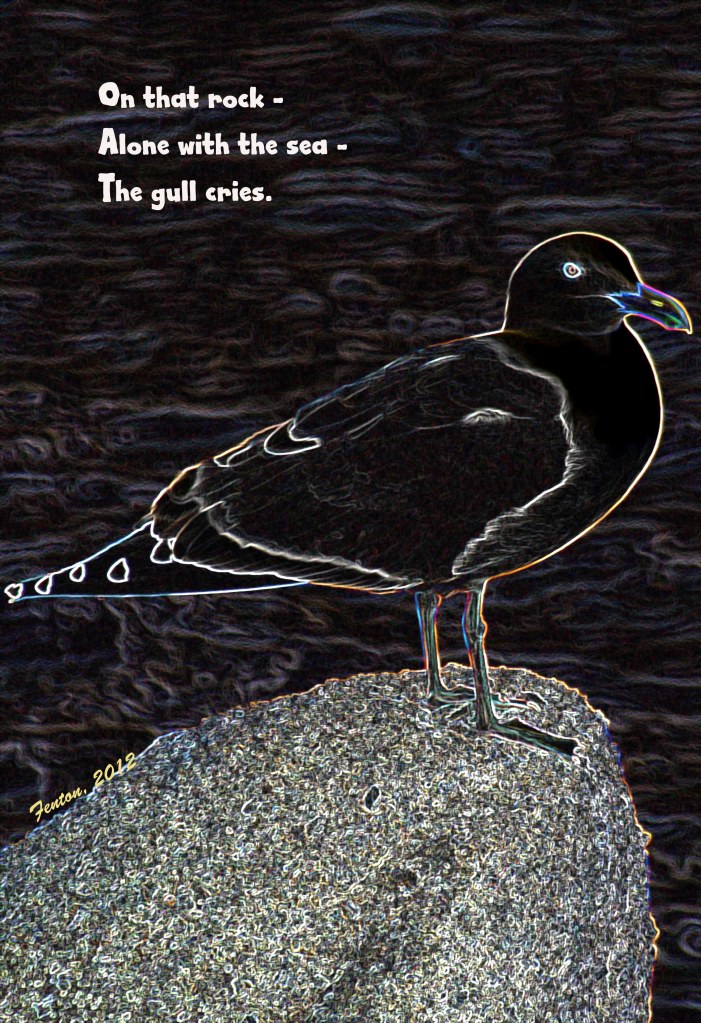
I tried to publish this Haiga about a year ago on an online Haiga page. Editor and I couldn’t agree on whether it was worthy and strong enough, or not. My take away on this one was that there is a tendency for editors to try too hard to form what they publish in their own image. That’s not necessarily bad, but it sure can result in some potentially good stuff going unseen – not that I think this is that good or that bad – but … So, if anyone out there in the blogosphere wants to let me know what they think – well, I’d be happy to hear from you.
By-the-bye, the photo that this image came from was taken at Monterrey Bay, not too far from the aquarium.
What is it about tropical forests that says “Forest Primeval”? The dense canopy that lets little sunlight reach the ground? The huge trees variously covered with lichens, bromeliads, vines, and algae? Tropical rain forest – stuff growing on stuff, growing on stuff. Subtropical oak-pine forests – lichens and huge trees. The national flower of Puerto Rico – a tiny orchid that grows on the moss and lichens on tree trunks. Belize – house plants climbing up tree trunks – vines hanging everywhere. El Volcan de Nieve, Mexico – 8,000 ft elevation – oak-pine forest. The ground is shaded, but there’s not the wild profusion of things growing on things. Rather, a profusion of understory shrubs and other plants. Fallen tree trunks covered with moss.
If one sits on a shaded veranda with a cold beer or a warm cup of coffee and listens during the day, there’s something of a cacophony of animal sounds. Mostly birds, but sometimes mammals or amphibians. At El Yunque, the dominant background sound is the call of the coqui frog. They live in the bromeliads up in the trees and call incessantly – co-qui, co-qui – aptly named. Around the villages in the mountains is heard the call of the domestic rooster – the national bird of Puerto Rico, it seems, since they are around every bend in the road.
At Chan Chich, it is birds. Parrots seem to predominate up in the canopy, but down at ground level, there are the melodious blackbirds and ocellated turkeys. The turkeys don’t have much to say, but the blackbirds are opera stars. Oropendolas are the dominant sound in the dawn chorus and a large part of the daily cacophony … and there are hummingbirds – no noise except for the chitter that accompanied a chase.
Two mammal sounds dominate the daytime at Chan Chich. At dawn, dusk, and at intervals throughout the day, there is the sound of howler monkeys. The various troops calling to let one another know where they are. Well-named – they produce a loud roar that seems like it should come from some fierce predator. On occasion, there may be the shrill scream of a distressed spider monkey. A young monkey, apparently abandoned by parents, swinging through the trees, making piteous cries.
Night in the Chan Chich forest. Frogs calling from small ponds and the river. The soft sound of running water. Insects – probably tree crickets or other leg violin players. Tracks along the footpath in the morning – El Tigre and a cub.
At El Volcan de Nieve, there is the call of trogons. A rather raucous call for such a beautiful bird – when they can be spotted. Bright red and green that disappears in the forest canopy. Lots of songbirds tweeting and twittering, but overall a quiet forest.
Night in the pine-oak forest is utterly quiet. No nearby ponds or streams to harbor frogs – and salamanders make no audible sound. Bats visiting night-blooming flowers and catching insects above the understory. Their calls are inaudible. Walking up a ridge, checking mammal traps at dusk – oppressive silence – is that soft sound El Tigre? Just after dawn at the top of the ridge, campfire ashes – still warm.
When I was a kid living in L.A. one of the great happenings in my life was when my uncle would come home from the service. He would regale me with tales of his adventures in India during the war. I particularly remember him taking me to the L.A. County Museum of Natural History. I didn’t get to go there very often, but I loved it when I did. We would walk around the African dioramas and I would marvel at the animals and the places depicted. The leopard display was among my favorites. It was set at night and the display was dark. As I walked up there were the bright, shining eyes of the leopard getting ready to leap out of the case from a tree limb.
The dioramas of early California were among my favorites. I especially remember one that showed vaqueros roping a grizzly bear. We would walk through the displays of shrunken heads from Borneo and the mummies from Egypt. Then there were the cases of bones from the La Brea tar pits. Saber-toothed cats with their long, sickle-shaped incisors (of course I didn’t call them incisors back then). The skeletons of mastodons, ground sloths and dire wolves all feature large in my memories of the museum.
In later years, as a biology student, I went back to the museum, but I entered through the staff door. I had become acquainted with the herpetologist on staff there and was bringing him some lizards that I had collected in Mexico for identification. After our meeting, I spent some time wandering in the museum like I had done as a child. There, in the Africa room, was the leopard – still getting ready to leap out of the dark from that tree limb.
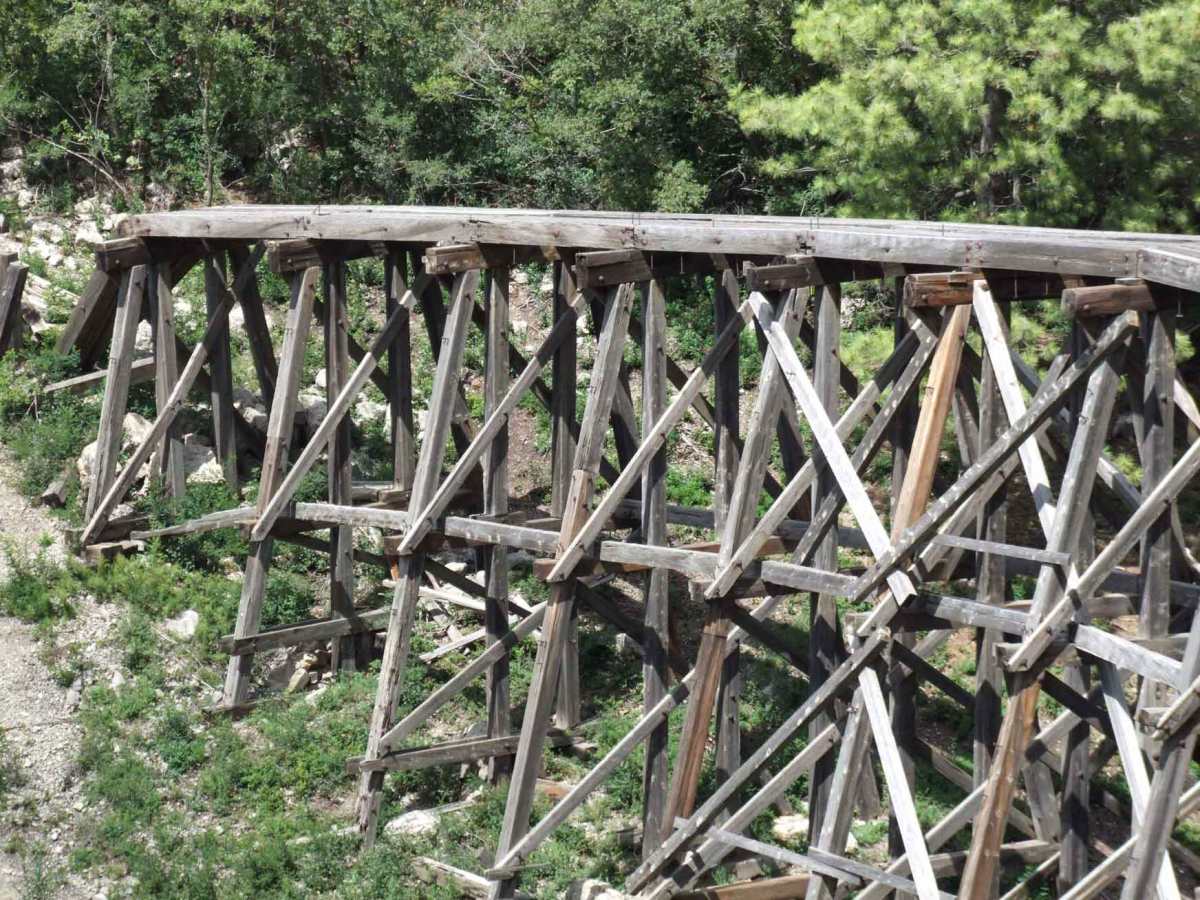
Just got back from our annual vacation trip. We took a big loop around New Mexico. Visited Chama, NM and rode on the Cumbres & Toltec railroad. Worth every penny we spent. Visited Chaco Culture National Historic Park – aka Chaco Canyon Ruins. Stopped by Taos, Zuni, and Acoma Pueblos. Parked our RV in KOA’s and other RV parks most nights.
But what I want to talk about is Chaco. They have a great campground. No amenities other than a parking space with a picnic table. But the scenic beauty is awesome and the quiet fairly thunders (but then so did the monsoonal rainstorms off to the west). It is one of the most pleasant RV camping spots we have visited.
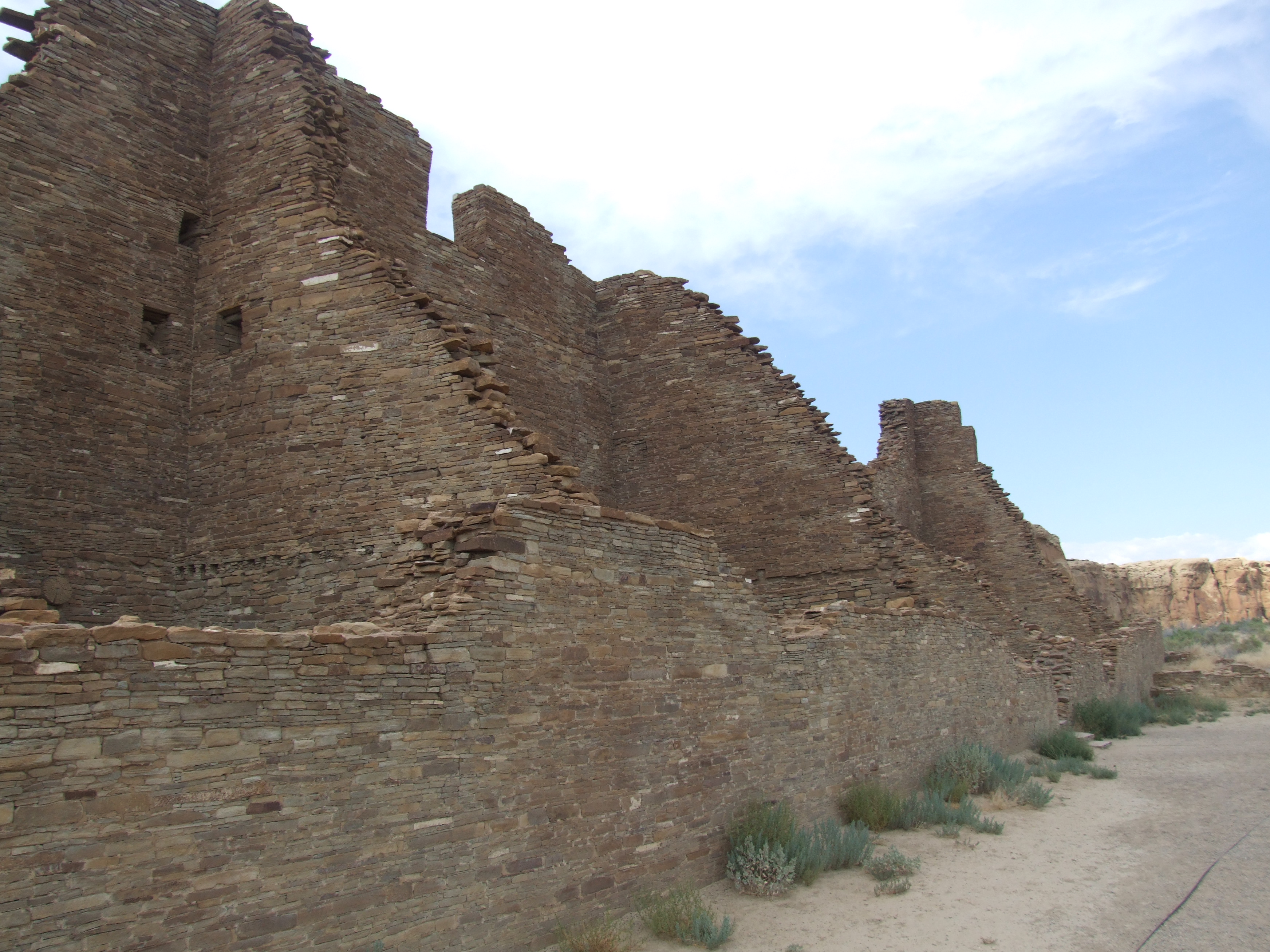
We didn’t visit all of the ruins, only Pueblo Bonito – the biggest and easiest to walk to. We stared at the others as we drove around their nicely laid out loop road. Pueblo Bonito is fantastic! The Chaco Culture must have been awesome when it existed. Three story buildings made of pieces of flat sandstone, mostly with little mortar – and that was mud. Floors and roofs made of vigas (logs) latillas (smaller logs) and mud. Interior walls plastered with mud. Chaco Canyon is an area of little water. Huge underground kivas that were roofed with pine logs and mud. The logs had to have been brought in from 60+ miles away – and remember so far as anyone knows, those people did not have the wheel or horses or mules or oxen – it was all people power. The effort, ingenuity, and engineering skill demonstrated in those ruins is phenomenal.
In addition to the monumental structures, the Chaco peoples built 30 ft wide roads that connected villages and cultures all over what is now New Mexico, Arizona, Colorado, and Utah. I believe there is evidence that they had contact with the Inca civilizations of Mexico. Many of the modern southwestern Native American tribes, especially the Pueblo peoples, the Hopi, and the Navajo have stories that link them to the Chaco Culture. The roads included grand staircases cut into the sandstone when they had to go over a butte or plateau.
Visiting places like Chaco Canyon and seeing the ruins of once-vibrant cultures that preceded the invasion of our European culture serves to remind me that we, today, may not be quite as hot as we think we are. How many of us know how to build a stacked stone structure that is three stories high? How many of us could transport big pine logs across inhospitable plains and over mesas without mechanical assistance? How many of us could design and construct highways wide enough to carry multiple persons of traffic both ways without bulldozers and graders? How many of us could conceive and build staircases that climbed sheer cliffs? Our modern culture is full of technological whiz-bang things, but we are not the only peoples that can develop technology and solve real-world problems. Those that came much before us were every bit as capable and solved monumental problems using the tools available to them and undoubtedly inventing new ones as needed.
I am tempted to try to write something using Chaco as the backdrop. It’ll be difficult to do, though. Tony and Anne Hillerman have set a very high bar for doing mysteries in Native America in the southwest. But, then a place as beguiling and mysterious as Chaco … who knows.
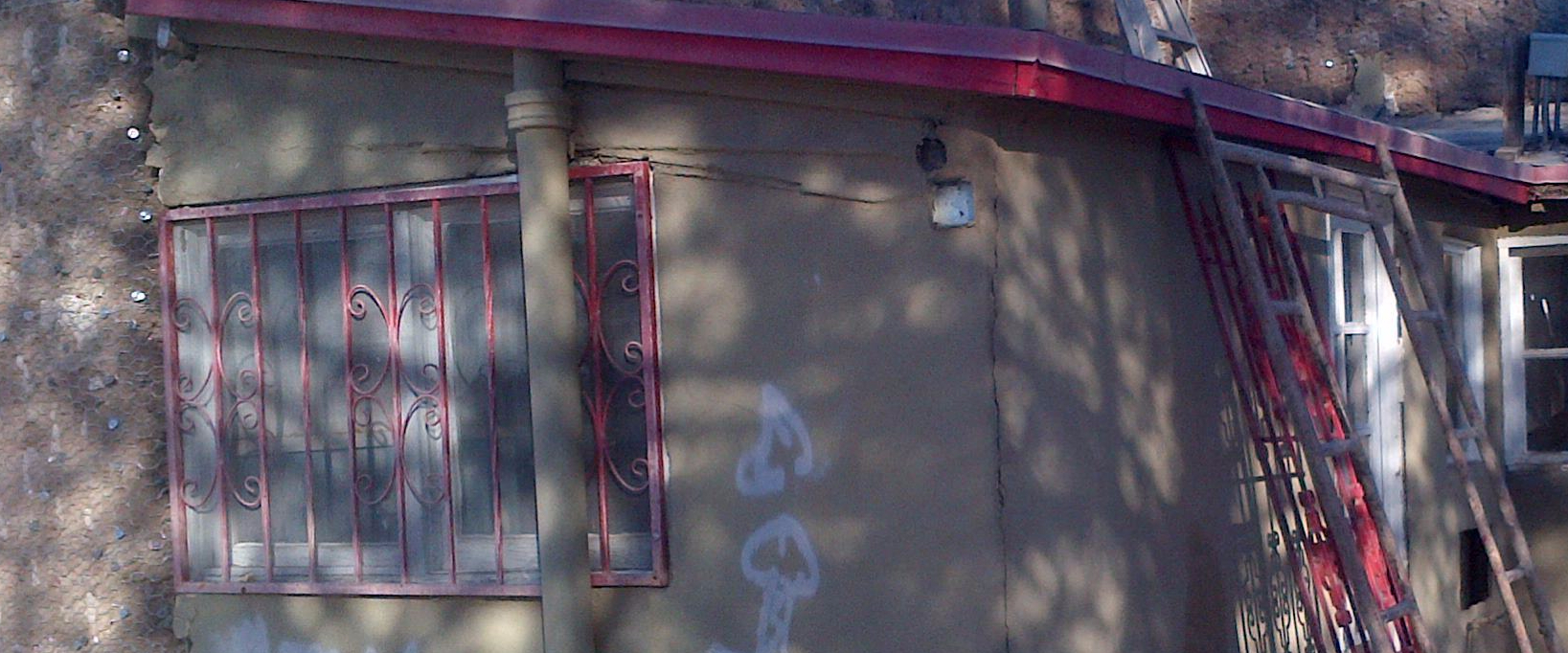
What is it about old houses that leads to the assumption they are haunted? Here’s an old adobe that was built in 1875. Is it haunted? I’ve been told that there are strange sounds inside. I’ve never heard them. Why would such a house be haunted? Because it’s old? Because someone died there a long time ago? One story that I have heard is that the man who built it died of pneumonia after he washed his hair in mid-winter. Would that be sufficient to make him a lost soul? Hmmm, people die in hospitals fairly frequently – does that suggest that hospitals should be haunted – maybe! How about the ones that die on the operating table – eh? Do they become lost souls?
As long as we are talking about why haunts might occur, I’d like to ask why so many haunts are women? Seems like, at least in our area, most of the haunts are women that have been wronged in some way – or brutally murdered. Don’t men get wronged – or murdered. I guess female ghosts just make for a better story. Like the story of La Llorona, the crying woman, that haunts the Rio Grande searching for her drowned child. I don’t know of any El Llorono – I guess men don’t go in search of their lost child.
What a fertile area to write about. No wonder there are so many books devoted to ghosts and rumors of ghosts. And there are just so many old, old houses and buildings in my area. I need to develop a protagonist that solves mysterious deaths in old buildings. Someone to discover the real reason for the strange sounds in the old courthouse, for instance.
I have worked all over the southwest during my nearly 50 years of experience. During that time I have worked for two state game and fish agencies and as an independent biological consultant – mostly doing sensitive species surveys and monitoring. Those work experiences have provided me with the opportunity to spend time in some interesting places.
The Clark Mountains, just into California from Nevada along I-15 between Los Angeles and Las Vegas, is one such interesting place. I spent time one spring doing desert tortoise monitoring along a gas pipeline through the Clarks. While I was there a huge migration of painted lady butterflies was going on. According to my late friend, colleague, and Curator of Lepidoptera at the University of Florida Natural History Museum, George Austin, such migrations only occur only periodically. About every 5 years or so there is a huge northward migration of painted ladys. Problem is, no one seems to know where the migration originates, why it occurs, or where it goes. I spent hours on a hillside surrounded by literally millions of butterflies as they floated, flapped, and flew by. They truly resembled autumn leaves, but they weren’t falling. Didn’t see a single tortoise.
I have recently watched a documentary on PBS about butterflies around the world. It seems that painted lady butterflies are ubiquitous. There is a huge migration of millions of them that originates in northern Europe and they fly all the way to Africa; across the Mediterranean. The return trip is done by multiple generations in stages, pretty much just like monarch butterflies in North America. I still don’t know what, where, why, or when on the migration of painted ladys that I witnessed.
My experience in the Clark Mountains has provided the location and situation for my novel, “Le Cochon Volant: The Flying Pig”.
In 1965, as an undergrad newbie in biology, I got the opportunity to do fieldwork in Mexico. Four of us, led by a Ph.D. student from University of Arizona and our professor from the University of Nevada, Las Vegas (then called Nevada Southern Univ, I think), traveled to a mountain on the border of Jalisco and Colima, Mexico. We set up camp at about 8,000 ft elevation in a tropical pine-oak forest and lived there for about 10 days. We trapped small mammals, collected birds, mist-netted bats, collected lizards and salamanders (they kept getting caught in our mammal traps), and prepared museum specimens of all of the stuff we caught. We were, in truth, “gutbucket biologists”.
It rained almost every day and cooking food was sometimes a real adventure. Hygiene was a challenge – so much so that when we got back to the U.S. and went into a restaurant to eat, we cleared the room. I got a mild case of “Montezuma’s Revenge”. One of the guys had a recurrence of amoebic dysentery that he had picked up in the Caribbean while in the Navy, and another got stung by a scorpion while were camped along the Rio Naranja on the way home. He was in bed for two days. Along that same river, we purchased a freshwater lobster from a local fisherman – it was delicious. I ate a mango for the first time and discovered what real ripe bananas were about.
It was a fascinating and highly educational experience, especially for someone that had just “found” biology. I learned more natural history in that interval than almost any other in my career. I hope to be able to use some of that adventure in a novel in the not too distant future.
As an aspiring novelist, I have been reading a bunch of the stuff that is online about what to do and how to do it if one desires to be published. Among the things that seem to be imperative is having a blog and posting to it. So, here I am developing a blog site on Word Press.
Just for giggles, I expect to post some of my very ancient and some more recent poetry. I’ll likely post little pieces of my novels and kids’ stories and hope to get some useful commentary from folks out there in the great blogosphere. I’ll most likely also ramble on occasionally with some of my observations regarding nature and the environment. I’ve accumulated a few idea and observations in my 50+ year career as a field biologist.
So, there you have it! Now let’s move forward and see where all of this goes.
 Fenton R. Kay's Website & Blog Page Menu